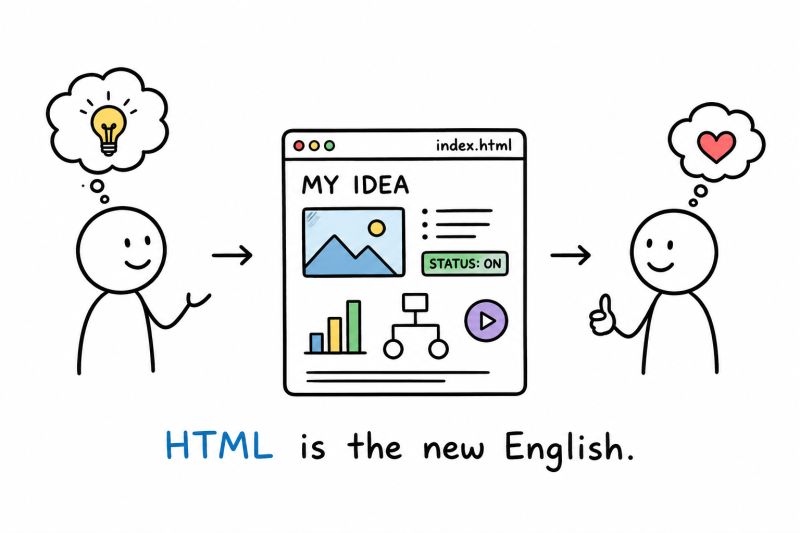
HTML Is The New English
Something has changed for me over the last few months.
More and more people around me are communicating less with documents and more with artifacts.
Even a few months ago, if someone had an idea, they might write a long Slack message, create a PowerPoint deck, draw a diagram on a whiteboard, or schedule a meeting to explain it.
Today, I increasingly see people do something different.
They describe the idea to AI and ask it to generate an HTML page.
Not because they are web developers.
Because it is often the fastest way to communicate.
A single page can contain text, diagrams, status indicators, animations, interactions, workflows, screenshots, colors, and examples. Instead of describing an idea, you can often show it.
Sometimes people don't even send the file anymore.
They host it somewhere internally and simply send a link.
"Take a look."
Then the feedback loop becomes interesting.
Someone opens the page, leaves comments, downloads it locally, asks AI to modify it, generates a new version, commits the changes, and shares it back.
The conversation is no longer happening only through words.
The conversation is happening through artifacts.
The interesting shift is that HTML is becoming less of a programming language and more of a communication language.
Not because everyone suddenly learned web development.
But because AI dramatically reduced the cost of turning thoughts into something visual, interactive, and shareable.
A surprising amount of modern communication is starting to look less like writing documents and more like exchanging prototypes.