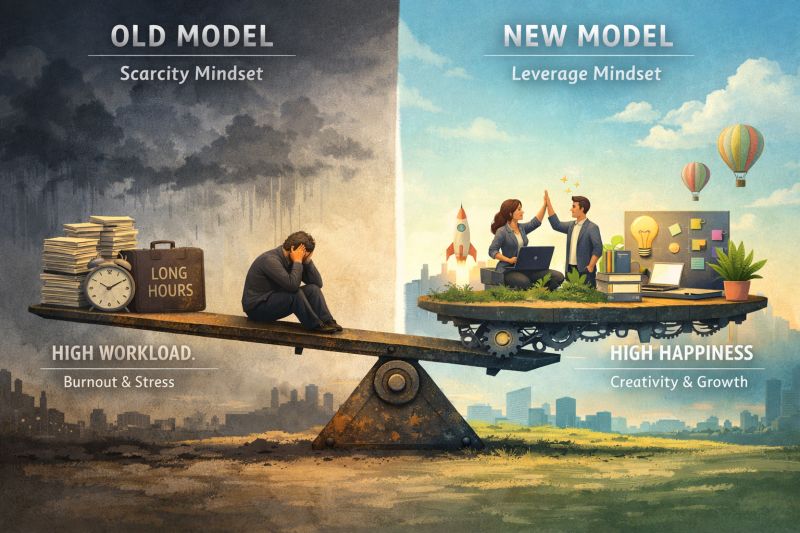
The 80% Happiness Rule
A long time ago, when I was working at a very traditional software company, our CEO told me something I never forgot:
You’re supposed to be about 80% happy at work.
More than that?
It probably meant you didn’t have enough workload.
Less than that?
It meant you were stressed.
At the time, this logic made sense.
Much of the work then was repetitive and execution-heavy. Output scaled with hours and pressure. Doing more usually meant feeling worse. So happiness and productivity naturally looked like a trade-off.
But the nature of work has changed.
Today, many people think for a living. They create, design, decide, and innovate. For this kind of work, repetition doesn’t create value — the quality of thinking does.
And recently, my own experience completely challenged that old 80% rule.
Over the past six months, my team scored 99% on happiness in our internal survey, especially around growth and satisfaction. At the same time, the team delivered results we genuinely couldn’t have imagined a few years ago — outcomes that actually changed the shape of the business.
They weren’t underworked.
They were stretched — but stretched with support.
What made the difference wasn’t pressure.
It was leadership conditions:
• meaningful problems
• clear goals with real ownership
• coaching, encouragement, and resources
• psychological safety to think well
For people who think for a living, the relationship flips.
You don’t get good thinking by pushing harder.
You get good thinking when people feel good enough to think clearly.
Working theory:
The idea that happiness and productivity cancel each other out is a legacy assumption from an era of repetitive work. In today’s creative and knowledge work, happiness isn’t the enemy of performance — it’s a multiplier.