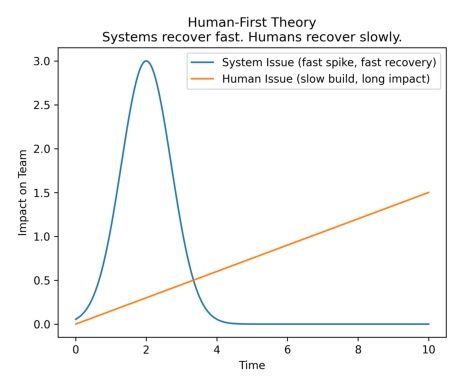
Human-First
Over time I’ve noticed an asymmetry in how problems behave inside teams.
Systems recover quickly.
Humans recover slowly.
A production incident can often be diagnosed and fixed with known playbooks.
A design mistake can be corrected in the next iteration.
Technical systems, while complex, usually have repeatable recovery paths.
Human issues behave differently.
Trust takes months to build.
Misunderstandings take time to unwind.
A damaged working dynamic can quietly affect a team for a very long time.
Of course, some system problems are genuinely urgent.
Security incidents, data loss, and safety issues demand immediate attention.
But outside of those true emergencies, I’ve noticed a pattern in busy teams:
When delivery pressure rises, leaders instinctively prioritize systems and postpone people problems.
Early in my management career, I made that mistake.
I sensed growing tension between two engineers on my team.
There were small signals — subtle disagreements, awkward conversations, reduced collaboration.
Nothing explosive. Nothing urgent.
So I waited.
Over time the tension grew.
Eventually the relationship became a drag on the entire team’s performance, and the situation ended with a restructuring of the team.
Years later, I encountered a very similar situation.
This time, when the first signals appeared, I acted immediately.
We had open conversations early, clarified expectations, and addressed the misunderstandings while the tension was still small.
The pattern never had the chance to grow.
That experience reinforced a rule I now try to follow:
Address human issues early, even when the schedule is tight.
Because systems usually have recovery playbooks.
Human dynamics rarely do.
And the highest-performing teams I’ve seen are not just technically strong —
they are teams where leaders protect the human system with the same seriousness as the technical one.