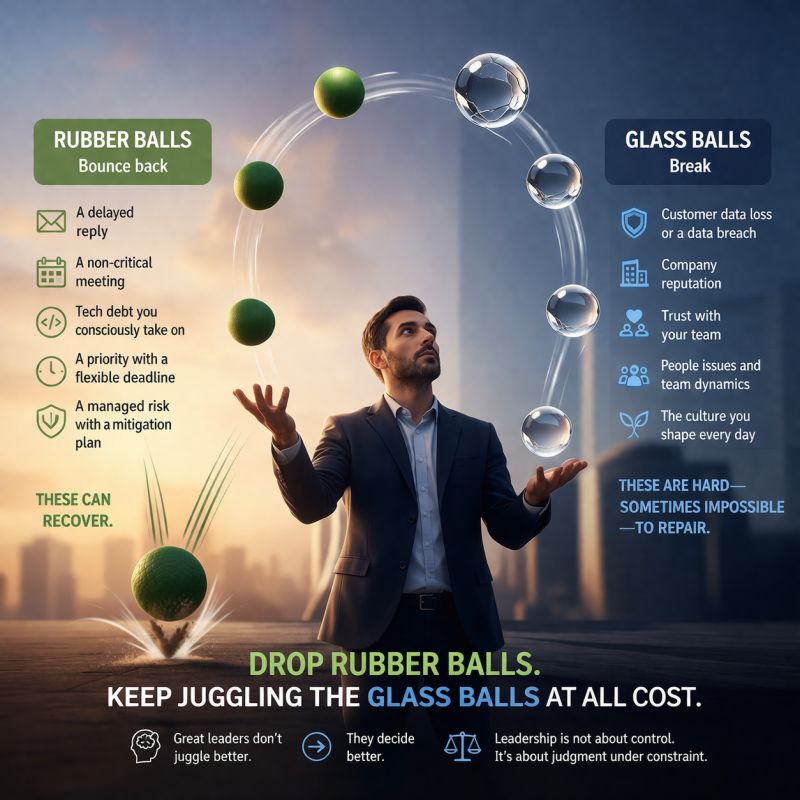
Juggling Ball Theory
As you grow into leadership, one thing becomes unavoidable:
👉 You will drop balls.
Not because you are careless —
but because it’s impossible not to.
Your day is full of things to respond to, decide, and push forward.
Each of them is a “ball” you are holding.
Early on, you can manage them all.
But over time, the number, weight, and impact all increase.
At some point, you are no longer holding —
you are juggling.
And once you are juggling, dropping is part of the job.
So the question changes:
👉 Not “How do I keep everything in the air?”
👉 But “Which balls can I afford to drop?”
Because not all balls are the same.
Rubber balls bounce back:
- A delayed reply
- A non-critical meeting
- Tech debt you consciously take on
- A priority with a flexible deadline
- A managed risk with a mitigation plan
These can recover.
Glass balls break:
- Customer data loss or a data breach
- Company reputation
- Trust with your team
- People issues and team dynamics
- The culture you shape every day
These are hard — sometimes impossible — to repair.
Great leaders don’t juggle better.
They decide better.
👉 Drop rubber balls. Keep juggling the glass balls at all cost.
Because leadership is not about control.
It’s about judgment under constraint.