Decision Timing Theory
Not all decisions should be made the same way. The key distinction is whether the system you’re operating in converges or keeps moving.
In small, contained problems — like planning a 3–4 person project — you can afford to wait. Availability, requirements, dependencies, and complexity can all be gathered and stabilized. The system converges, and once enough variables settle, the decision naturally becomes clear.
But in larger, multi-quarter initiatives, the system behaves differently. Inputs don’t converge — they evolve. People change, priorities shift, dependencies expand, constraints emerge, and trade-offs multiply. By the time you collect the information, it is already outdated. There is no clean “ready” state.
At that point, waiting is no longer a path to clarity. It becomes a trap.
A useful way to think about this is:
Decision Value = Information Value − Delay Cost
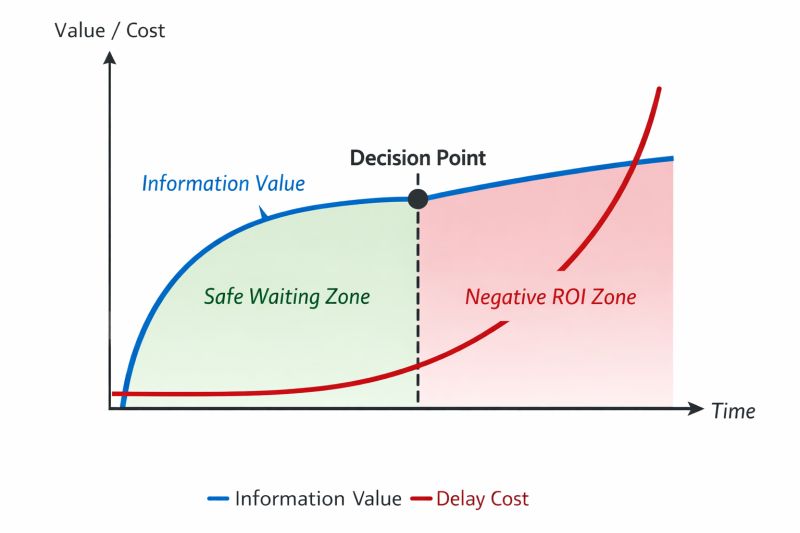
In converging systems, information value grows faster than delay cost, so waiting improves decisions.
In non-converging systems, delay cost grows faster than information value, because the system itself keeps changing.
There is a tipping point where:
d(Information Value)/dt < d(Delay Cost)/dt
Beyond this point, every additional unit of waiting reduces overall outcome quality.
That is the moment most teams miss.
Instead of asking “Do we have enough to decide?”, the better question becomes “When will we decide?” — defining a clear decision threshold based on time, key signals, or bounded assumptions.
In simple systems, you wait for clarity.
In complex systems, you create the moment of decision.
Good leadership is not just about making better decisions.
It’s about knowing when waiting stops helping — and deciding anyway.
⸻