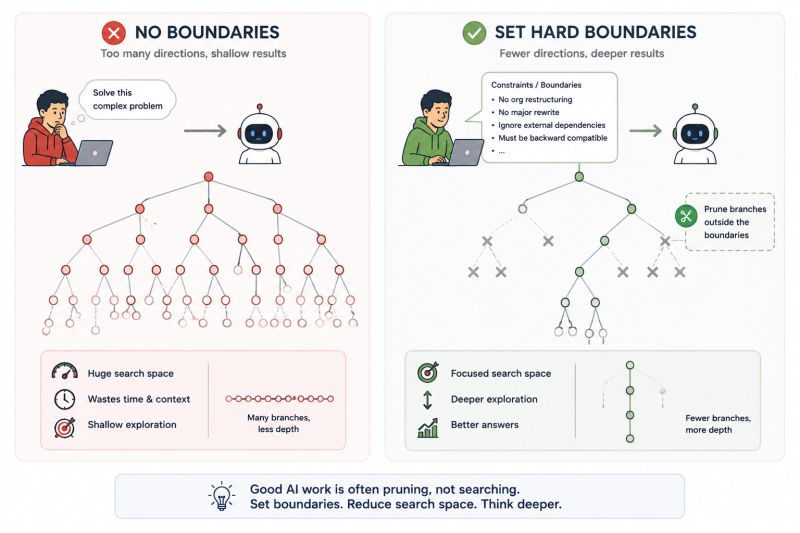
AI Playbook (Part 4: Set Hard Boundaries)
One mistake I increasingly notice with AI is starting exploration without clear boundaries.
When solving a complex problem, AI can generate an enormous number of possible directions. That sounds powerful, but in practice it often creates noise.
The problem is not intelligence.
The problem is search space.
If you leave everything open, AI starts exploring too many branches at once: rewrite the architecture, reorganize teams, rebuild systems, change ownership, redesign workflows, rethink dependencies, optimize adjacent problems, and so on. Before long, the discussion becomes broad, expensive, and cognitively exhausting.
I increasingly find it useful to define hard boundaries before asking AI to reason.
Sometimes the rule is:
> “Do not assume organizational restructuring.”
Sometimes:
> “No major rewrite.”
Or:
> “Ignore dependencies outside this team.”
Or:
> “Assume this system must stay backward compatible.”
The point is not to artificially limit thinking.
The point is to deliberately reduce the search space.
In computer science terms, it feels a bit like pruning branches from a search tree. By removing paths we already know are unrealistic, too expensive, or simply outside scope, AI spends less effort wandering and more effort thinking deeply where it matters.
The surprising thing is that stronger constraints often produce better answers.
Less breadth.
More depth.
More focus.
Because better reasoning is often not about exploring everything.
It is about deciding what not to explore.