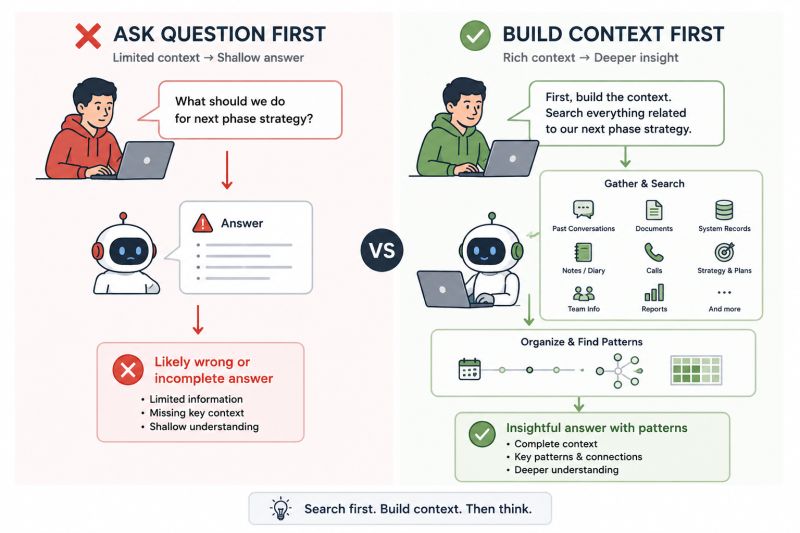
AI Playbook (Part 2: Search Before Thinking)
One mistake I increasingly notice with AI is starting with an opinion too early.
We often open a chat and ask:
> “What should we do?”
But for complex problems, that is usually too early.
Before asking AI to reason, I increasingly try to let it search first.
If I am planning a strategy, reviewing a cost problem, thinking about next-phase priorities, or investigating a system issue, I first ask AI to gather everything remotely relevant: past conversations, documents, records, planning notes, logs, historical decisions, company strategy, previous incidents, dependencies, customer context, and anything else that may matter.
The point is not to overwhelm AI with information.
The point is to reconstruct the environment around the problem.
Then I ask it to organize the information: by timeline, by themes, by org boundaries, by dependencies, or by cause-and-effect relationships. Only after the context becomes visible do I ask:
> what patterns do you see?
> what assumptions repeat?
> where are the bottlenecks?
> what changed over time?
That is usually when surprising insights appear.
Sometimes the problem itself changes.
Sometimes the original question turns out to be wrong.
Sometimes a pattern becomes obvious only after months of decisions, incidents, and trade-offs are placed on the same timeline.
The biggest shift for me is this:
Don’t start with prompting.
Start with reconstruction.
Because good reasoning is often downstream of good context.