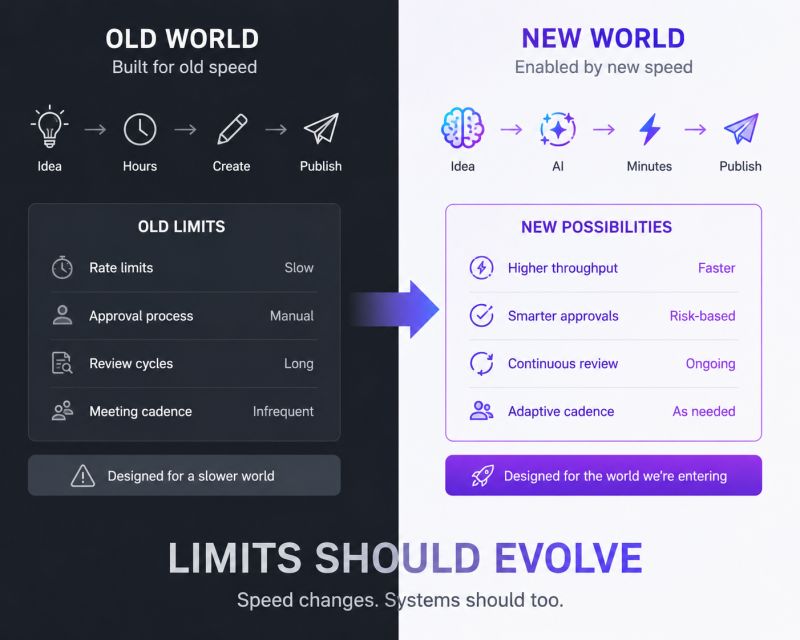
When The World Speeds Up, Old Limits Break
Yesterday LinkedIn temporarily rate-limited me because I posted three times within roughly 5–10 minutes 😄
From LinkedIn’s perspective, this probably looked suspicious. In the old world, producing several reasonably thoughtful posts within minutes looked much more like automation than human behavior.
But what actually happened was simple: I had a few ideas, discussed them with AI, pressure-tested them, rewrote them, and posted them. What previously might have taken hours now took minutes.
The interesting part is not LinkedIn itself. It is the assumption behind the limit.
Many systems are designed around assumptions of human speed: how quickly people think, write, review, decide, respond, or create. Those assumptions made sense when the pace of work changed slowly. But AI changes throughput. A draft becomes editable in minutes. Analysis becomes faster. Iteration compresses. Work that previously moved weekly sometimes moves daily, or even hourly.
This raises a broader question for leaders and system designers: what are the hidden rate limits inside our organizations?
Approval processes, review cycles, meeting cadence, escalation paths, planning timelines — are these still shaped for the world we are entering, or for the one we came from?
Some limits still protect quality and trust.
Some may simply be protecting assumptions that no longer exist.