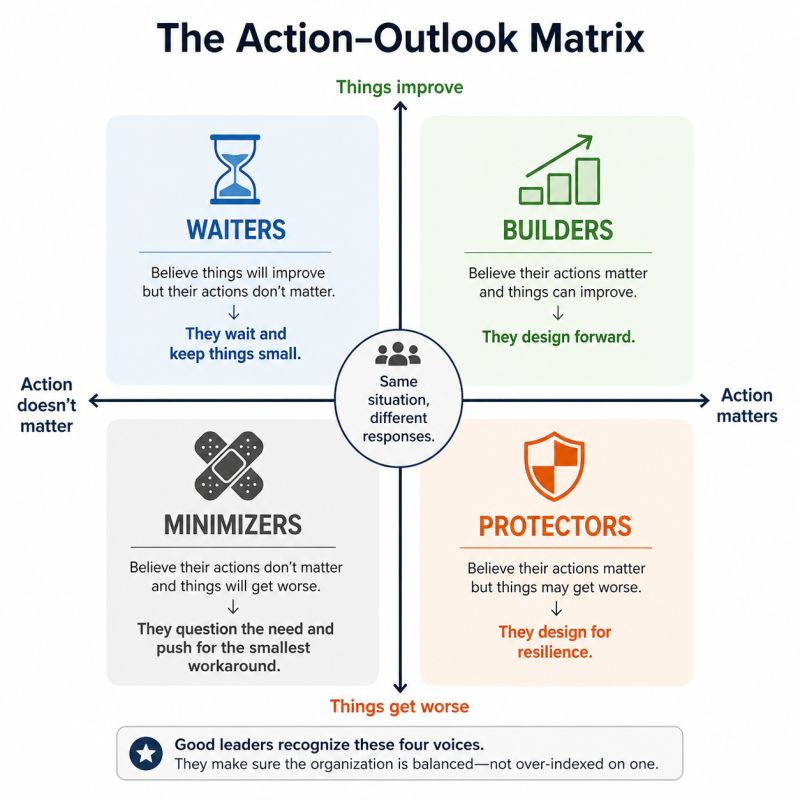
The Action–Outlook Matrix
People tend to operate from two beliefs:
Will my actions change anything?
And is the future getting better or worse?
---
Those two beliefs shape how we behave.
---
Take a common situation.
A team needs to make a design choice.
Build a more complex, generic system
with potential for the future,
or build something smaller
that solves immediate needs
but may not scale well.
---
There are too many dependencies.
It’s not clear what the future will require.
---
Four response modes show up.
---
The Builders
believe their actions matter and things can improve.
They design forward.
---
The Protectors
believe their actions matter but things may get worse.
They design for resilience.
---
The Waiters
believe things will improve but their actions don’t matter.
They wait and keep things small.
---
The Minimizers
believe their actions don’t matter and things will get worse.
They question the need and push for the smallest workaround.
---
Same situation.
Very different systems get built.
---
Good leaders don’t try to eliminate these differences.
They recognize them.
---
They make sure the organization doesn’t over-index on just one voice.
Too many Builders → over-engineering.
Too many Protectors → slow decisions.
Too many Waiters → missed opportunities.
Too many Minimizers → short-term patches.
---
The goal is balance.
---
Because the best outcomes
usually come from tension — not uniform thinking.