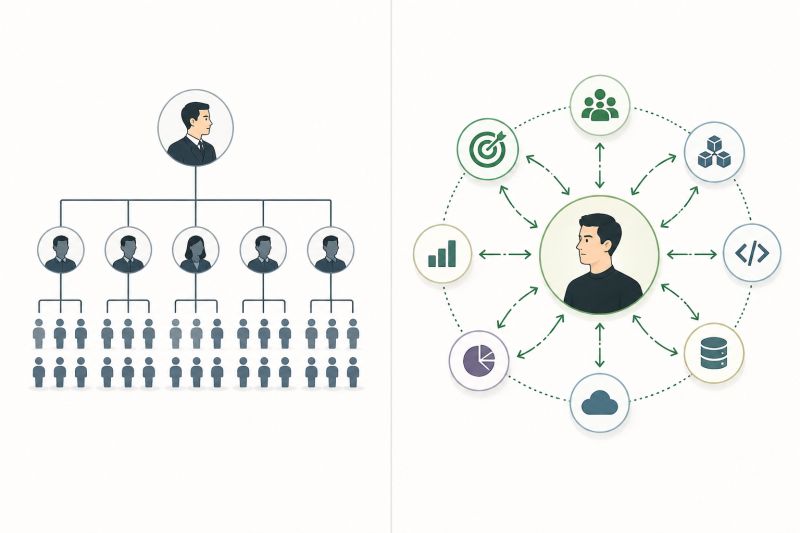
The Domain Size Theory
Traditionally, we use two signals to judge how senior a leader is:
Title
Org size
---
How big is the team?
How many people report to them?
---
That made sense.
Because in the past,
problem size scaled with team size.
---
Bigger problem → more people
More people → more senior leader
---
That mapping is breaking.
---
With AI,
small teams can now handle much larger domains.
Fewer people,
but significantly more complexity.
---
You can already see it:
Small startups building products
that compete with much larger organisations
Leaders owning end-to-end systems
that used to require multiple teams
---
So the signal is shifting.
---
It’s less about how many people you manage.
It’s more about what you own.
---
Not tasks. Not projects.
Problem domains.
---
For example:
Owning whether an entire product ecosystem stays up or breaks
Owning how customer needs become real products
Owning how products connect, evolve, and scale across the company
---
These are large surfaces of complexity.
---
But there’s a more personal signal.
---
You know your seniority is increasing when:
important problems
cannot bypass you
---
When your input is needed
before decisions are made
When your judgment shapes the direction
When your absence creates a gap
---
That’s not about control.
It’s about ownership.
---
Not headcount.
But domain size.