Fish Fun Production Line
The pipeline that turned a six-year-old's drawings into a 400-page hardcover — with art treated like code.
Problem
There is a real tank in our living room with four real fish, and a daughter who spent a year drawing their imagined adventures — by hand, in pencil, more than a hundred of them. The pile deserved better than a drawer, but a printed book demands consistency a six-year-old's output cheerfully ignores: print-safe resolution, bleed and gutter margins, one coherent visual world across a hundred pages.
Context
The guiding principle was written down on day one: when technical perfection conflicts with the authenticity of a six-year-old's imagination, always choose authenticity. Isabelle is the author — every adventure, composition and speech bubble is hers, told in her words and drawn by her hand. AI worked strictly as the colouring and production assistant, finishing her own linework for print, never inventing a page. Every creative question — what's happening, who is who — came from her description, never from a model's guess.
Design
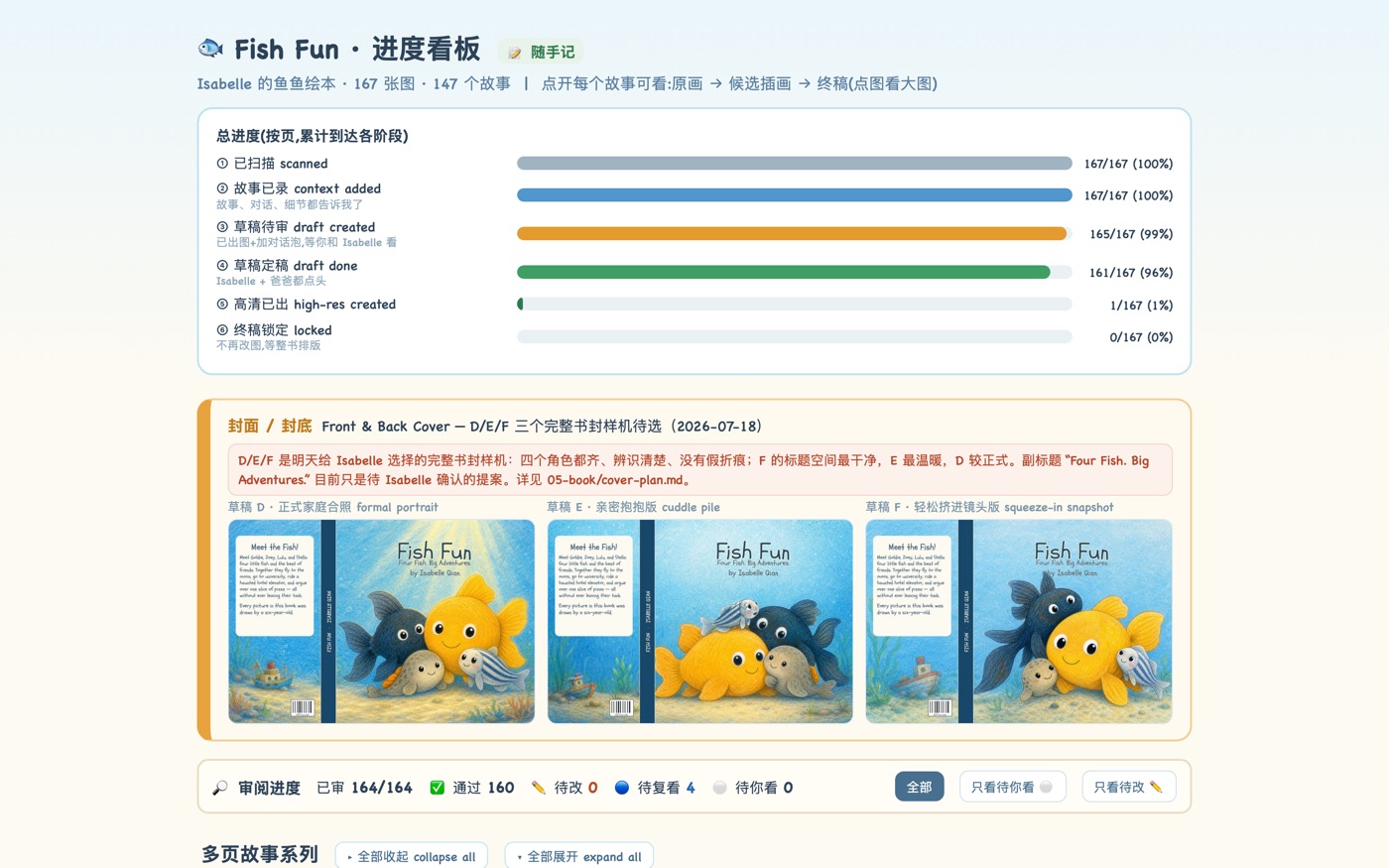
A folder pipeline any engineer would recognise: originals → stories → illustrations → print pages → book. Each drawing got a stable intake ID assigned once and never renamed, linking the scan to her verbatim story, the dialogue map, the prompts, the enhanced artwork and the final print page.
Consistency came from two binding documents — a character bible for the four fish and a style guide for everything else — and from audits run per page: emotion audit, guest-fish check, no invented characters or props.
Implementation
Python tools for everything: enhancement of faint pencil scans, per-page compose scripts with kid-lettering for speech bubbles, a build script that assembles the whole book as facing spreads, and QA scripts that re-hash every locked image. A voice-note inbox let stories be captured from a phone the moment she told them.
When the page review finished, all 166 page images were frozen — read-only copies plus a SHA-256 manifest, exactly like a release lock. The final interior went to KDP as a 400-page premium-colour hardcover after a physical proof; screen-only approval was never allowed.
Lessons learned
Treat art like code and the whole project calms down: single source of truth for the current version of every page, checksums against silent regressions, an audit script for drift. The one production incident — compose scripts on eleven pages quietly writing to files the book never used — is exactly the class of bug the manifest was built to catch.
The success metric was written before the tooling: not sales — a keepsake Isabelle will still love reading in twenty years. Every technical decision got easier once that was the test.
Future ideas
A classmate gift edition — the production recipe survived the first print run and is documented, so the second book is mostly a decision, not a project.